Looks like meat, but this is Fistulina hepatica, the beefsteak fungus.
Beefsteak fungus is one of the most distinctive edible mushrooms. It may look and feel meaty but it has a strong, distinctive, astringent taste all its own.
Below is a photo of a typical specimen in situ, click here for a more remarkable fruiting body.
Fistulina hepatica - beefsteak fungus. Typical fruiting body exuding clear red liquid.
It grows out of oak and sweet chestnut trees - and it is probably the tanins in the wood that give the fungus its flavour.
As always, bear in mind that there are plenty of poisonous fungi out there - never eat anything you cannot positively identify as a good edible.
Previously I discovered that you can get pleasingly blue food by mixing red cabbage with egg. I now understand that all the egg is doing to the red cabbage is raising its pH. The same effect can be achieved by adding a little baking soda to minced red cabbage. However, the colour doesn't seem to be very stable - cooking or drying the mixture seems to alter the colour from blue to a paler, sea-green shade.
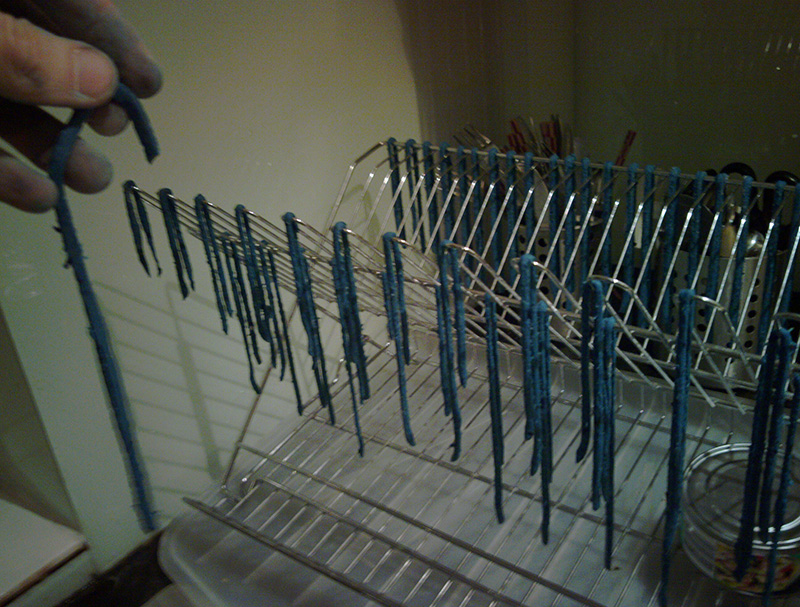
I mixed my blue minced cabbage to a standard dough (strong white flour, salt, water) and used it to make udon noodles - they went a bit green while being boiled in the soup, but still tasty!
I also tried making chapatis out of the dough, but they went very green.
Chapatis - one with baking soda - turning the red cabbage blue green, the other without.
So instead I baked some white bread rolls and glazed them with blue cabbage juice after they came out of the oven. This produced the most successful colour, but seems more like home made food-colouring rather than blue food per se.
I added a little aniseed to my bread mix - synesthetically speaking, it is one of the bluest of flavours!
I love carob! The trees are shady, shapely evergreens dotted around in many mediterranean lands. The tree's fruits are large pods, reminiscent of giant runner beans.
As a food, it gets a bad reputation from being used as a chocolate substitute, but as an ingredient in its own right, carob can be wonderful - it is dark and bitter-sweet and can be used as a flavouring in both savoury dishes and desserts. Curries, bread making and muesli can certainly all be spiced up with the addition of a bit of carob powder.
I first started looking for mushrooms with a set of friends who were (and still are) keen on foraging for wild food. We would go to a nice place and wander round looking for mushrooms, on finding one we would leaf through a field guide, almost always fail to identify it, then move on. Occasionally we would come across something that one of us recognised as a good edible, and we would pick them, go home and prepare a feast!
I always felt dissatisfied at the vast number of mushrooms that we failed to identify, and so, one year I decided to 'learn my mushrooms' I went out several times a week, wandering far and wide, noting particularly mushroomious spots and returning regularly to witness the annual succession of fungi. At first I could identify very little - I would bring specimens home and leaf through guide books for hours, often having to give up without pinpointing what species I had found, but over the weeks I started to recognise some of the more distinctive ones, and the process continues to this day - filling in the gaps, making ever finer distinctions. There are still many that I can't tell apart.
I was identifying more and more edible mushrooms - and finding rarer and less familiar forms. There is always a risk involved in collecting wild mushrooms - every year people die from eating poisonous mushrooms, and most of those people are not idiots: they are smart people who think they know what they're doing - like me! There is also something overly acquisitive about mushroom hunting - you stumble across a beautiful patch of boletes and immediately - whomp! they are plucked and stuffed in your bag, ready for the pot.
These two considerations persuaded me to move from mushroom eating to mushroom photography as my primary form of appreciation - there is such beauty and variety in the textures, forms and colours that I find unending enjoyment from photographing and recording what I find, and pushing myself to improve my identification and seeking skills.
Mushroom hunting is an excellent pastime - it involves spending quality time in some beautiful countryside, gentle exercise, and an almost unending variety of species to find and identify. Every time you go out, you are likely to find something new. You just need to be satisfied with only being able to identify a small proportion what you see, at least at first.
The Fly Agaric - one of the very easiest mushrooms to positively identify.
The down-sides? It is a pretty seasonal activity, and you must always *ALWAYS* be 100% sure of your identifications if you plan on eating anything.
Boletus erythropus - a nice bolette which stains an intense blue when the flesh is cut. Disappointingly, the blue fades to nothing upon cooking, leaving you with a fairly ordinary looking mushroom dish.
Does that count as blue food? When it comes to blueness, raspberry flavoured Slush-Puppies are still hard to beat.
I've known about the beautiful colours produced when one combines egg yolk and red cabbage for years, but am only now starting to experiment.
Here is the first fruit of my labours: an omelette made with fried, shredded red cabbage.
I think I may be able to get more intense colouration by leaving the mixture to stand for a while before cooking. It was also somewhat overdone - better over cooked than under cooked as a general rule.